Showing posts with label Sacraments. Show all posts

Thursday, October 25, 2007

Just a couple of reasons

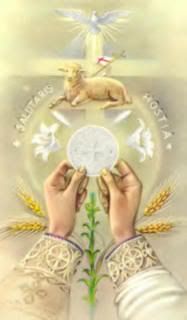
to receive Holy Communion on the tongue


St John Chrysostom says that the hand that touches the sacred flesh of Jesus Christ, and the tongue that is purpled with His Divine Blood, should be purer than the rays of the sun.

"Who," St Augustine exclaims, "shall be so wicked and daring as to touch the most Holy Sacrament with polluted hands!"

"Because out of reverence towards this sacrament, nothing touches it, but what is consecrated; hence the corporal and the chalice are consecrated, and likewise the priest's hands, for touching this sacrament." - ST. THOMAS AQUINAS, Summa Theologica

Sacraments and Grace

I often hear talk on Catholic Answers Forums that even though a priest may be offering Mass unworthily (in a state of mortal sin) that you still receive the same graces you would as if you received the sacraments from a priest who is in a state of sanctifying grace. And the Council of Trent does indeed teach that the Holy Mass cannot be contaminated by the malice of priests. St Alphonsus de Liquori, Doctor of the Church says that when a priest offers Holy Mass in a state of mortal sin, he is striking Jesus with his own hands. And St Augustine says, "Those that unworthily offer Jesus Christ in heaven sin more grievously than the Jews who crucified Him when he was upon earth."

Isaias 1:15 And when you stretch forth your hands, I will turn away my eyes from you: and when you multiply prayer, I will not hear: for your hands are full of blood.

St Theresa of Avila, while approaching the Communion rail one day, once saw a devil on each side of a priest who celebrated Mass in the state of mortal sin. The devils trembled in the presence of the Holy Sacrament, manifesting the desire to flee. From the consecrated Host, Jesus said to St Theresa, "Behold the force of the words of consecration, and see, O Theresa, My goodness which makes me willing to place Myself in the hands of my enemy for your welfare, and for the welfare of every Christian."

Pray every day for the sanctity and holiness of our priests. Their responsibility before God is tremendous, and they need our prayers.

Monday, September 03, 2007

Canon 916

Can. 916 Anyone who is conscious of grave sin may not celebrate Mass or receive the Body of the Lord without previously having been to sacramental confession, unless there is a grave reason and there is no opportunity to confess; in this case the person is to remember the obligation to make an act of perfect contrition, which includes the resolve to go to confession as soon as possible.


This appears in the front cover of the OCP hymnal "Breaking Bread" (which I had my first introduction to last week on vacation). It is a Canon I am familiar with, and one that I have seen people misinterpret to mean they can receive Communion in a state of (grave/mortal) sin as long as they go to confession right after Mass. I know people in my own church who follow this practice of receiving Communion and going to confession right after Mass, using this Canon as their rationale for doing so.

An act of perfect contrition (which is required in this case) is being sorry for offending God with your sins because you love Him above all things, and an act of imperfect contrition (which isn't enough in this case) is being sorry for your sins because you dread the pains of hell.

Canon 916 requires a grave reason to exist for the application of receiving Communion without confession. What I see people using as grave reason are 1) not having confession scheduled prior to Mass, and 2) arriving at Mass too late to ask the priest hear your confession. My gut feeling on this is that neither of these qualify as grave reasons to receive Holy Communion as outlined by Canon 916 if you are conscious of mortal sin.

It takes a certain degree of humility to stay in your seat and abstain from Communion when everyone else is receiving Communion. Maybe I'm being scrupulous here, but neither of the two situations I outlined above seem to be qualify as grave matter. What would you do?