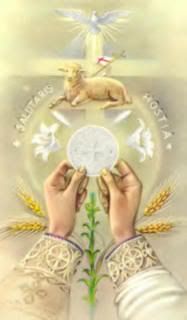
I find it very distressing when people, especially the Catholic faithful, slam priests. I just had a phone conversation with a lady from my parish who is in charge of the Catechism program - I was signing up to teach grades three and four- and partway through our discussion this woman started to tell me things I didn't want to hear about a priest I consider a friend. I told her to stop and pray a Hail Mary, but she just continued on, informing me of things I didn't need to know, and quite frankly, don't believe. I do know that this priest encountered difficulties as a pastor of this very liberal parish when he purchased kneelers for the pews and tried to have them installed. He was moved shortly afterwards, and I believe the kneelers are collecting dust in a closet somewhere. Several times I told this woman to pray for the priest she had difficulties with, but she kept on with her tirade - that is, until I said, "Stop right there! Let's get back to discussing Catechism. I don't need to know any of things you are telling me."
There is a prayer for priests in my Pieta book. I may slip her a copy when I meet her at my first Catechism class. Prayers are what priests need most, not criticism.
Keep them, I pray Thee, dearest Lord,
Keep them, for they are Thine -
Thy priests whose lives burn out before
Thy consecrated shrine.
Keep them, for they are in the world,
Though from the world apart;
When earthly pleasures tempt, allure, -
Shelter them in Thy heart.
Keep them, and comfort them in hours
Of loneliness and pain,
When all their life of sacrifice
For souls seems but in vain.
Keep them, and O remember, Lord,
They have no one but Thee,
Yet they have only human hearts,
With human frailty.
Keep them as spotless as the Host.
That daily they caress;
Their every thought and word and deed,
Deign, dearest Lord, to bless.
Showing posts with label catechism. Show all posts
Showing posts with label catechism. Show all posts
Tuesday, September 14, 2010


Thursday, June 17, 2010
Water and the Holy Ghost
On Pentecost Sunday, as our priest was delivering his sermon, he gave the most interesting analogy of the Holy Spirit. It's one I have never heard before, but will certainly remember for when I teach catechism again. It would also come in handy for helping others to understand how there are three Persons in one God. Here it is:
Water comes in different forms. There is ice, vapour, and liquid water. They are all the same thing - water - even though they take different forms.
Interesting, isn't it? It just might help someone to grasp that difficult concept.
Water comes in different forms. There is ice, vapour, and liquid water. They are all the same thing - water - even though they take different forms.
Interesting, isn't it? It just might help someone to grasp that difficult concept.
Wednesday, May 21, 2008
Indulging in the Treasury of the Church
An indulgence to most people is a box of chocolates, a good bottle of wine, or any other number of self-rewards for the body. They bask in the enjoyment of some well-deserved pleasure, relishing the moment.
To a Catholic, however, an indulgence is a means of gaining spiritual rewards. Specifically, it is the remission by the Church of temporal punishment due to sins which have already been forgiven.
How does the Church come by this treasury of graces, and under whose authority can she dispense them? The Catholic Church holds a Treasury of Graces called indulgences that were earned by the infinite satisfaction of Jesus Christ, through His Passion, Death and Resurrection, as well as by the superabundant satisfaction of the Blessed Virgin Mary and the saints, especially the martyrs.
The Blessed Mother lived a pure and sinless life, yet she suffered much, and had no need to use her many sufferings to expiate any sins of her own, because she was free from all sin from the moment of her conception. Her complete faith and love of God, united with her sufferings she endured alongside her Divine Son, (especially during His Passion), earned immeasurable graces for the treasury of the Church. All these graces, earned by Jesus and the saints, are at the disposal of the Church. The Catholic Church draws on this heavenly treasury to give remission to her members of the punishment due for sins that have already been forgiven.
Indulgences should not be overlooked in your spiritual journey towards heaven. We already know that they lessen or cancel the temporal punishment due our sins, but did you know they also console us as we consider the pains of Purgatory, giving us hope for less punishment of our own? And they encourage us to confess our sins so that we can obtain the graces the indulgence offers. Think of it a spiritual carrot dangling before you, well within reach if you will only grasp for it.
There are four conditions necessary to obtaining an indulgence. First, you must be baptized. Second, you must fulfill the conditions of obtaining the indulgence, which usually mean receiving Communion and praying for the Pope's intentions. Third, you must be in the state of grace; you cannot have mortal sin on your soul. Fourth, you must have the intention of earning the indulgence. A person can gain an indulgence only for himself or for the souls in Purgatory. You cannot gain an indulgence for another living soul. Only one plenary indulgence per day can be earned.
We have all seen indulgences written below certain prayers that say things like “5 years indulgence” etc. Many people have mistakenly thought this meant they would receive 5 years off their Purgatory. It is actually written as a comparison to five years of penance that would have been done in the early days of the Church, and according to the rules of the Church of that time. It is only through the mercy of God that we will know exactly how much punishment due our sins that the indulgences we have earned on this earth will benefit us.There are two kinds of indulgences: plenary and partial. Partial indulgences remit only part of the temporal punishment due your sins. A plenary indulgence takes away all the temporal punishment due your sins. This means that if you died immediately after receiving a plenary indulgence, you would go straight to heaven! To obtain a plenary indulgence, you must:
1) have the intention of gaining the indulgence
2) go to Confession and be free of all sin including venial sin at the time of saying the required prayers.
3)meet the four requirements mentioned earlier,
4) You must also not be in the habit of committing any sin, whether it is mortal or venial.
Plenary indulgences can be gained by:
- Adoration of the Blessed Sacrament for at least one hour
- Making the Way of the Cross or, if unable to get to a church, the pious meditation and reading on the Passion and Death of Our Lord for a half an hour
- Private recitation of five decades of the Rosary. This must be done vocally, continuously, and while meditating on the Mysteries
- Public recitation of five decades of the Rosary. This must be done vocally, continuously, and with the Mysteries announced out loud and meditated on.
- A plenary indulgence is granted on each Friday of Lent to the faithful who after Communion piously recite before an image of Christ crucified the prayer: "Look down upon me, good and gentle Jesus." On the other days of the year the indulgence is partial.
- A plenary indulgence is granted to the faithful who renew their baptismal promises in the liturgy of the Easter Vigil
- A plenary indulgence is granted when an Act of Consecration is publicly recited on the feast of the Sacred Heart of Jesus
- A plenary indulgence is received by those who publicly make the Act of Consecration of the Human Race to the Sacred Heart on the Feast of Christ the King (last Sunday in October per the traditional calendar, last Sunday of Pentecost per the Novus Ordo calendar)
- A pious visit to a church, a public or chapel on All Souls' Day (November 2) with the prayers of one Our Father and the Creed; this indulgence is applicable only to the Souls in Purgatory.
- A devout visit to a cemetery with a prayer, even if only mental, for the departed souls, from the first to the eighth day of November.
Monday, May 19, 2008
Sanctifying your Sunday
The third commandment tells us to keep holy the Lord's day by going to Mass, engaging in other spiritual exercises or reading, and by not engaging in servile work, other than what is necessary for our family, or required for the good of our neighbour or the honour of God.
That means no shopping, other than necessities like food or gas, according to my priest. I recently asked him if it's alright to stop at a certain store that I only pass by on my way to Mass every Sunday, to pick up a few (unnecessary but convenient) items. He said no, that it would be breaking the third commandment.
I have come to terms with the no shopping except food and gas rule, but I still struggle with how much work around the house I can get away with on Sunday. My hobby is gardening and landscaping. (Yes, I really do have a hobby outside of blogging!) Yesterday, after Mass, I did some spiritual reading (The Glories of Mary and Imitation of Christ), prayed the rosary and the chaplet, My God I love Thee, - so far so good- then I headed out to the yard and started planting a new garden for ornamental grasses. I ran short of plants, so I headed to the nursery for more. Not only did I engage in servile work, which really could have waited until today, but I went shopping for plants.
How much work is too much? If it's your hobby do you allow yourself to "work" on Sunday? I'd be interested to hear readers opinions on what is proper for keeping the Lord's day holy.
That means no shopping, other than necessities like food or gas, according to my priest. I recently asked him if it's alright to stop at a certain store that I only pass by on my way to Mass every Sunday, to pick up a few (unnecessary but convenient) items. He said no, that it would be breaking the third commandment.
I have come to terms with the no shopping except food and gas rule, but I still struggle with how much work around the house I can get away with on Sunday. My hobby is gardening and landscaping. (Yes, I really do have a hobby outside of blogging!) Yesterday, after Mass, I did some spiritual reading (The Glories of Mary and Imitation of Christ), prayed the rosary and the chaplet, My God I love Thee, - so far so good- then I headed out to the yard and started planting a new garden for ornamental grasses. I ran short of plants, so I headed to the nursery for more. Not only did I engage in servile work, which really could have waited until today, but I went shopping for plants.
How much work is too much? If it's your hobby do you allow yourself to "work" on Sunday? I'd be interested to hear readers opinions on what is proper for keeping the Lord's day holy.
Friday, May 16, 2008
Contrition

Tears of St. Peter, 1647, by artist Guercino, shows St Peter crying before the Blessed Mother for his sin of denying Jesus three times during His Passion. Notice how the white cloth collecting the tears of sorrow stands out, and the sorrowful expressions of St. Peter and the Blessed Virgin Mary.
According to the Catechism, true contrition must have four qualities: it must be interior, meaning that our contrition is sincere; it must be supernatural, which means we are sorry because we offended God; it must be supreme, which means we hate sin above all other evils and are willing to endure any suffering rather than keep offending God by sin; and it must be universal. This last one means we must be sorry for at least all the mortal sins we have committed, including those in our past.
The Church teaches us that there is perfect contrition and imperfect contrition. Perfect contrition means that we are sorry for our sins because we love God above all things and are sorry for having offended Him. If we make an act of perfect contrition to God after committing a mortal sin, our sin is forgiven, but we still must go to confession as soon as possible, and before receiving Holy Communion.
Imperfect contrition occurs when we are sorry for having offended God because we are afraid of the punishments of Hell, or because our sins are hateful in themselves. Imperfect contrition is sufficient to receive forgiveness in the Sacrament of Penance.
Like St. Peter, we can achieve perfect contrition if we only meditate on the goodness of God, and love Him because He is all good and worthy of all our love. We should make frequent and fervent acts of love to God every day. Here is a little prayer you can say anytime, anywhere:
"Oh, my God, I love thee with all my heart, all my soul, all my spirit and all my strength."
Subscribe to:
Posts (Atom)


.JPG)


 Posts
Posts